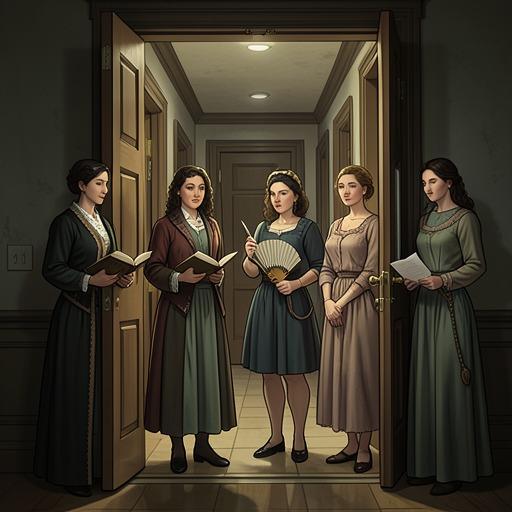
Elizabeth Bennet–Mary Bennet sisterhood
Just DesertsThe Elizabeth Bennet–Mary Bennet sisterhood is one of the quietest but most consequential relationships in the Bennet family. Mary begins as the plain, bookish, overlooked middle daughter, while Elizabeth is treated as the vexatious one; over time, however, their intellectual similarity brings them into a close alliance. They become able to judge marriage and male conduct by standards deeper than appearance, money, or social convenience, and Mary ultimately recognizes Elizabeth’s sacrifices, hidden generosity, and right to marry for love.
Identity and Early Family Position
Mary Bennet occupies the difficult middle position among the five Bennet sisters. At eleven, she is still a child and is described as the plainest of the daughters only in comparison with siblings who are striking in different ways. Since her birthday, she has spent much of her time reading the Bible. Her place in the household is shaped by contrast: Jane is the beautiful daughter, Lydia most resembles Mrs. Bennet in temperament, Kitty follows Lydia, and Elizabeth is the troublesome or vexatious daughter. Mary is therefore neither the family beauty nor its dominant personality, and her seriousness does not receive the same attention given to Lydia’s demands.
That neglect becomes especially visible at the Netherfield gathering. Elizabeth performs a short piece and sings an aria before giving up the piano, while Caroline Bingley follows with technically superior playing. Mary then has to perform after Caroline’s “ruthless precision,” despite being largely self-taught. Before Mary can establish herself, Lydia interrupts by demanding music for dancing, and Mrs. Bennet humiliates her by declaring that nobody wants to listen to her concertos. Elizabeth sees the scene as a social mortification inflicted on Mary by both mother and younger sister, not as evidence that Mary deserves less respect.
From Middle Child to Intellectual Ally
Elizabeth’s understanding of Mary changes during the autumn of 1811. Jane remains Elizabeth’s closest sister, but Mary increasingly appears as the sister most similar to her in habits of thought and expectations of other people. Jane complements Elizabeth through her gentleness and optimism; Mary shares more of Elizabeth’s exacting judgment and is less naive about love, marriage, and gentlemen. Their bond is therefore not founded only on childhood affection. It grows from recognition: each sees in the other a mind unwilling to accept the standards that govern the rest of the household.
The sisters cannot precisely state what they want in a gentleman, but they know what they reject. Their list includes the local young men, the oily and obnoxious William Collins, and the three supposedly respectable men of the Netherfield party. This shared negative judgment is important because it gives Mary and Elizabeth a common language of refusal. They are not yet presenting a fully articulated ideal of marriage, but they can identify the forms of male conduct and social performance that they will not accept.
As a result, the older sisters cease to function as two pairs with Mary stranded between them. Jane, Elizabeth, and Mary become a close trio. Kitty and Lydia remain joined by Lydia’s dominance, although Elizabeth and Mary both perceive that Kitty might improve if she escaped Lydia’s influence. The sisterhood thus becomes part of a broader reorganization within Longbourn: Mary is no longer merely the child in the middle but one of the three older sisters whose judgments carry mutual weight.
Marriage, Agency, and Shared Standards
Mary’s closeness to Elizabeth is especially visible in the sisters’ attitude toward marriage. Elizabeth rejects William Collins rather than allowing herself to be treated as a solution to the problems of Longbourn. When she explains the refusal to the Gardiners, she insists that a bride cannot be forced to marry and that she will not be sold for the estate. She also invokes the biblical warning that parents should not provoke their children to anger, contrasting it with the more commonly quoted command that children obey their parents. Mary’s reading and moral seriousness help give Elizabeth confidence that her interpretation is not merely rebellious self-justification.
Elizabeth’s conflict with Mrs. Bennet is not presented as a simple absence of affection. Elizabeth questions whether her mother has ever loved her and concludes that Mrs. Bennet certainly loves Longbourn more than she loves Elizabeth. Mary belongs to the small circle of sisters who understand the force of that distinction. Their shared exactness about marriage allows them to recognize that material security cannot substitute for respect, emotional attachment, or personal choice.
Elizabeth later states that any marriage of hers will not be a loveless or soulless transaction, even though that determination opposes society’s expectations. Mary’s own standards are not reduced to a romantic fantasy; rather, they represent a refusal to confuse marriage with purchase. In this respect, the sisters’ alliance opposes the household’s social logic, in which daughters are treated as instruments for preserving property, reputation, or parental comfort.
Secrecy, Protection, and Forgiveness
Elizabeth’s secret relationship with Lady Radha Pentland creates a limit within the sisterhood. Elizabeth does not initially tell Mary or Jane that she regularly visits Grenadine Reef. She fears that disclosure would force them either to lie to their parents or to reveal Elizabeth’s secret. The concealment torments her for more than eight years, but she admits that she would make the same choice again. The secret is therefore both a wound and an act of protection: Elizabeth withholds trust from her sisters, yet does so to prevent them from being placed in an impossible moral position.
The relationship with Lady Radha Pentland also gives Elizabeth an education in estate management and in a marriage based on mutual love. Lady Radha’s experience of surviving pirate captivity, being rescued and cared for by Sir David Pentland, and being accepted by him without regard to what happened during her four days with the pirates becomes part of the knowledge Elizabeth carries back into the Bennet household. Through these lessons, Elizabeth comes to see marriage as partnership rather than property. Although she does not openly share the source of all her ideas, Mary becomes one of the sisters shaped by their consequences.
When Elizabeth finally explains her hidden life, Mary does not answer with indignation. Jane speaks for the sisters and acknowledges that Elizabeth rescued the family when Lydia nearly ruined it, covering Lydia’s stupidity without anyone knowing what she had done. She also learns that Elizabeth is working to secure dowries of £25,000 for each of the three older sisters, a provision intended to help them marry well. Mary’s forgiveness is contained within this collective response: Elizabeth’s secrecy is judged alongside the protection, money, education, and sacrifice that secrecy enabled.
Change, Recognition, and Narrative Significance
The sisterhood changes from unequal family placement to reciprocal recognition. Mary begins as a child diminished by comparison and publicly humiliated at the piano, but she becomes one of Elizabeth’s closest intellectual companions. Elizabeth, in turn, stops treating Mary as merely the plain or serious sister and recognizes her as someone whose judgments about affection, marriage, and male character are reliable. Their connection gives both women a position from which to resist the emotional and economic pressures of Longbourn.
Mary’s final response also confirms the ethical center of Elizabeth’s choices. Elizabeth has been loved by Lady Radha Pentland and Sir David Pentland in ways that resemble grandparental care, supported by Edward Gardiner and Madeline Gardiner, and prepared to protect her sisters materially. Mary sees that Elizabeth is not rejecting marriage itself but rejecting marriage without love. She therefore understands Elizabeth’s union with Fitzwilliam Darcy as the fulfillment of the principle the sisters have shared: Elizabeth is marrying “for the deepest love.”
The relationship’s significance lies in its quiet counterweight to the family’s louder conflicts. Lydia and Kitty’s alliance is based on imitation and dominance; Mrs. Bennet’s influence turns insecurity into pressure; the entail makes daughters vulnerable to economic calculation. Against these forces, Elizabeth and Mary build solidarity through observation, moral scrutiny, and eventual forgiveness. Their sisterhood shows that intimacy need not depend on identical temperaments: it can emerge when two women recognize the same injustice and refuse to let social convenience define the meaning of love, duty, or family.